The Occulted Apparatus: How Declining Empires Weaponize Irrationalism
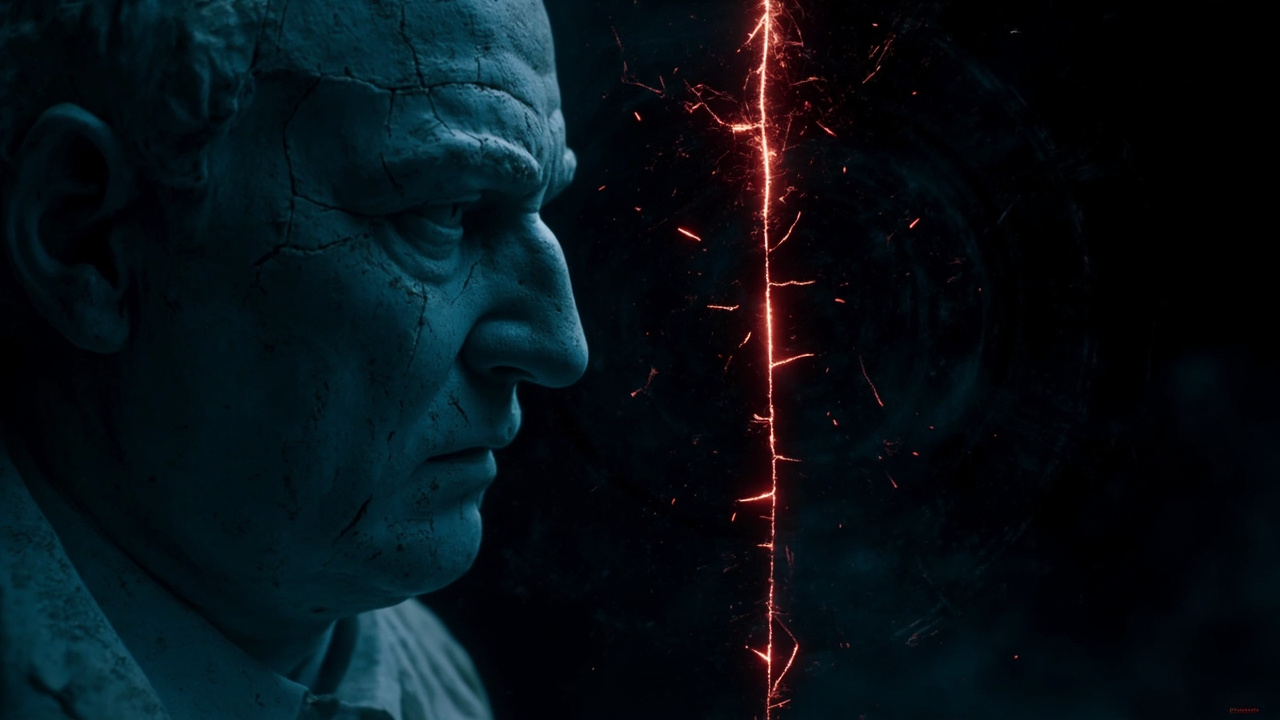
The Occulted Apparatus: How Declining Empires Weaponize Irrationalism
There is a 150-year structural pattern in which declining hegemons sabotage independent multipolar economic development by deploying covert networks, and those networks reliably gravitate toward occult irrationalism — not because anyone believes the magic, but because irrationalist loyalty structures provide something rational institutions cannot: unbreakable elite cohesion without accountability.
This is not a conspiracy thesis. It is incentive architecture. And if you understand the mechanism, you understand why Palantir — a private company with no democratic mandate — now controls the predictive policing and military AI decision-making infrastructure of a nuclear-armed nation-state.
I. The Architecture That Was Destroyed
Otto von Bismarck is poorly understood. The popular image — militaristic Prussian strongman — is a caricature that survives because it serves everyone who needed him gone.
The actual Bismarck, documented across his own memoirs and decades of diplomatic scholarship, was a realist who fought three short wars between 1864 and 1871 to unify Germany, then spent the next twenty years doing everything possible to preserve peace in Europe. His policy was explicit: Germany does not seek dominance, does not seek global empire, does not seek naval rivalry with Britain. Germany seeks stability, industrial development, and above all, good relations with Russia.
Alexander Mercouris, in a recent Duran discussion with Matthew Ehret, laid out the Bismarck architecture accurately. It deserves restatement because the architecture itself — not the man — is what was murdered.
Confidence: High. This is mainstream diplomatic history, not revisionism.
Bismarck’s system rested on four pillars:
-
German-Russian friendship as the keystone of European peace. Bismarck stated this repeatedly and acted on it. He understood what every serious geostrategist understands: the stability of Eurasia depends on the relationship between its two largest continental powers.
-
Sovereign credit creation for industrial development. Bismarck was deeply influenced by the American System — the Hamiltonian/Listian tradition of state-credit-funded infrastructure, protective tariffs, and industrial policy. He admired Lincoln. He studied the greenback system. He implemented the world’s first social security system and universal secondary education on the American model.
-
A multipolar alliance structure. Bismarck maintained the League of the Three Emperors (Germany, Russia, Austria-Hungary), kept France diplomatically isolated after 1871, and avoided entangling commitments that could drag Germany into colonial adventures.
-
Rejection of Weltpolitik. Bismarck explicitly opposed the idea that Germany needed a global empire, a world-class navy, or a “place in the sun” beyond Europe. He considered these ambitions dangerous, destabilizing, and ultimately self-defeating.
This architecture was not utopian. It was cold, calculated realism — and it worked. From 1871 to 1890, while Bismarck remained chancellor, there was no major European war.
Then he was ousted.
II. The Sabotage Pattern
Kaiser Wilhelm II dismissed Bismarck in 1890. The reasons were personal vanity, court intrigue, and the growing influence of the Weltpolitik faction — the same people Bismarck had spent twenty years restraining. Within the Camarilla surrounding the Kaiser, Bismarck was framed as a threat to the throne. Wilhelm, resentful of Bismarck’s towering public stature, was easily manipulated.
Confidence: High for Bismarck’s ouster and its consequences. Confidence: Medium for the degree of foreign manipulation in the Camarilla — the evidence suggests domestic factionalism was the primary driver, with external encouragement a contributing factor.
What followed Bismarck’s removal was not merely bad policy. It was a systematic campaign of assassination and sabotage that eliminated every major statesman who could have maintained the peace architecture. This is documented, not speculative:
-
Sadi Carnot, President of France (assassinated 1894). Carnot was aligned with the Bismarckian faction seeking positive Franco-German-Russian industrial cooperation. His assassin: an anarchist. The anarchist networks of this period warrant separate examination.
-
Walther Rathenau, German Foreign Minister (assassinated 1922). Rathenau was the architect of the Treaty of Rapallo — the German-Russian normalization that would have broken Germany free of Versailles debt slavery without resorting to extremism. His murder destroyed the last serious attempt at a peaceful German-Russian rapprochement. The organization Consul, responsible for his death, was the paramilitary precursor to the SS.
-
Between 1919 and 1924, an estimated 300+ German political figures were assassinated, almost entirely by right-wing extremist networks operating with implicit establishment tolerance. The Weimar judiciary systematically failed to convict. The pattern is too consistent to be coincidence and too documented to be conspiracy.
Confidence: High. The assassination counts and the organizational links to what became the SS are established in mainstream German historiography.
The result of this systematic decapitation was exactly what one would predict: a leadership vacuum filled by radicals, an economy crushed by Versailles reparations and hyperinflation, a population radicalized by trauma, and the rise of a movement — National Socialism — that was funded by the same Wall Street and London financial interests that had engineered the sabotage.
This is the point Matthew Ehret makes that is structurally correct, even where his specific evidence varies in quality: the extreme left and the extreme right were both cultivated, funded, and positioned to collide. The synthesis that emerged from their manufactured conflict was Nazism. Hegelian dialectic as a weapon, not a philosophy.
III. The Occult-Intelligence Complex
Here is where the analysis enters territory that sounds like fiction and is, unfortunately, documented fact.
Confidence levels are marked per claim below. Everything in this section is sourced to publicly available scholarship, not to the podcast’s connective inference.
Aleister Crowley and British intelligence. Richard Spence, a credentialed historian at the University of Idaho, published Secret Agent 666: Aleister Crowley, British Intelligence and the Occult (2008), using archival sources to demonstrate that Crowley was likely recruited by British intelligence (through Lord Glascon Cecil) before joining the Hermetic Order of the Golden Dawn. Spence documents Crowley’s deployment to Russia to establish intelligence networks, his later operations in the United States, and his probable role in the Lusitania affair — passing intelligence to German networks about munitions aboard the passenger ship, creating the conditions for a U-boat attack that would break American isolationism and draw the US into World War I.
Confidence: Medium-High. Spence’s work is peer-reviewed archival scholarship. The specific Lusitania claim is his strongest inference; the general intelligence-linkage is well-supported.
Gérard Encausse (Papus) and the Russian court. Papus — the leading figure of the Martinist Order and a pillar of the French occult revival — positioned himself as physician and adviser to Nicholas II at the precise historical moment when the Protocols of the Learned Elders of Zion were introduced to the Russian court. The Protocols were a forgery, plagiarized directly from Maurice Joly’s Dialogue in Hell Between Machiavelli and Montesquieu (1864) — a political pamphlet against Napoleon III that had nothing to do with Jewish conspiracies. But the forgery served a function: it convinced the already-paranoid Nicholas II to fire competent ministers like Sergei Witte, to intensify persecution of Jewish populations (creating revolutionary pressure-cooker conditions), and to distrust international financial networks that might have stabilized Russia.
Confidence: High for the forgery (universally acknowledged by historians). Confidence: Medium for Papus’s operational intelligence role — the overlap between occult positioning and court influence is documented; the intentional coordination with British intelligence is inferred, not proven.
Colonel Michael Aquino and Mind Wars. Aquino was simultaneously the second-in-command of the Church of Satan and a highly placed US Army psychological operations officer. He conducted a working ritual at Wewelsburg Castle in 1969 (the SS’s ideological center, where Himmler had established his “black sun” templar headquarters). He then co-authored From PSYOP to Mind Wars (1983) for the US Army, a doctrine document that explicitly invokes Arthurian imagery — calling the Mind Wars program “Excalibur” — and calls for the integration of ESP operations, occult-type training, psychedelic experimentation, and electromagnetic weapons into military doctrine.
This is not the plot of a thriller. This is a declassified document written by a Satanist with a security clearance.
Confidence: High. The document is publicly available. Aquino’s military career and Church of Satan role are both matters of public record.
The pattern. Crowley (Golden Dawn + British intelligence). Papus (Martinist Order + Russian court manipulation). Aquino (Church of Satan + US Army PSYOP). The same structural overlap recurs across a century: occult organization + intelligence function + elite access + operational impact on major geopolitical events.
IV. Why Irrationalism? The Mechanism
The question that matters is not whether these individuals believed their own rituals. The question is why this pattern recurs. What structural function does occult irrationalism serve for intelligence and power networks?
Confidence: Medium-High. This is structural analysis, not empirical proof. The mechanism is logically sound and consistent with the observable pattern, but has not been subjected to formal verification.
Three functions:
1. Loyalty that survives institutional collapse. Rational institutions — constitutions, laws, oaths of office, professional ethics — are designed to be transparent, accountable, and replaceable. They are also designed to be captured. An oath to the Constitution can be reinterpreted by activist judges. A security clearance can be revoked by a political appointee. But an oath made under ritual conditions, to a secret order, with a bloodline initiation structure, is far harder to capture from outside and far harder to betray from inside. Occult loyalty structures are capture-resistant by design. That is their functional value to declining powers who can no longer rely on institutional loyalty to survive.
2. Elite cohesion across borders. A diplomat, a financier, a military officer, and a publisher in four different countries share no institutional loyalty. But if all four are initiates of the same order — Golden Dawn, Martinist, Templar, Thule, whatever the designation — they share a bond that transcends their national obligations. This is the structural reason why occult networks appear at every major geopolitical inflection point: they are the private protocol layer beneath the public protocol layer of nations and treaties. When the public layer fails or is sabotaged, the private layer carries the operation.
3. Psychological transformation of operators. Alexander Mercouris, who worked at the Royal Courts of Justice and directly reviewed files on active occult groups in Britain, noted that the recruitment pattern skews heavily toward military officers who have experienced combat trauma. This aligns with the documented pattern of post-Vietnam satanic-ritual activity in the US and the post-WWII occult revival among British intelligence networks. The mechanism is straightforward: men who have done things that no human should do — Operation Phoenix, mass civilian killings, torture programs — require a framework that can absorb moral injury without breaking. Orthodox Christianity says: repent. The occult says: you are beyond good and evil; you are initiated; you are more than human. For a power structure that needs operators who can execute amoral orders without psychological collapse, the occult is not a luxury. It is infrastructure.
This is the mechanism. Not belief. Function.
V. The Modern Endpoint: Palantir
The through-line from Crowley to Palantir is not a bloodline conspiracy. It is an institutional continuity — bad habits, shared assumptions, and incentive gradients that persist because the structural conditions that produced them have not changed.
Palantir Technologies, founded by Peter Thiel, now holds contracts to manage the AI decision-making infrastructure of the British military and municipal policing systems. The UK government has awarded Palantir increasingly expansive access to both defense intelligence and domestic predictive policing — the capacity to monitor financial transactions, online communications, and behavioral metrics to predict and pre-empt criminal activity before it occurs. Minority Report as procurement policy.
Confidence: High. The contracts are public record.
Matthew Ehret raises an additional data point: Palantir UK’s CEO is Louis Mosley, whose grandfather was Oswald Mosley — leader of the British Union of Fascists. Ehret further notes that JFC Fuller, Oswald Mosley’s second-in-command, was the Grandmaster of the Argentum Astrum Crowley lodge and innovated Blitzkrieg tactics whose manuals are still taught at West Point. According to Mosley’s own account, Palantir CEO Alex Karp recited a 1939 Oswald Mosley speech from memory during their meeting.
Confidence: Low-Medium. The Mosley family connection is factual. The Karp anecdote is self-reported by the parties involved and has not been independently verified. The operational significance of the connection — whether it reflects continuity of ideology or merely the eccentric personal history of a tech executive — is speculative. We mark it as suggestive, not proven.
But here is what does not require the Mosley connection to be alarming:
A single private corporation, accountable to no electorate, now controls the surveillance and prediction infrastructure that governs both the external military posture and internal policing of a sovereign nation. The mechanism is not occult. It is banal. It is contract law, procurement policy, and regulatory capture — the same mechanisms Libertaria has diagnosed across every domain from finance to media to AI.
Palantir is the rationalized descendant of the occult-intelligence complex. It does not need ritual initiations. It has stock options. It does not need secret oaths. It has NDAs. It does not need the Golden Dawn. It has a monopoly on the predictive infrastructure that makes dissent statistically identifiable before it becomes politically effective.
The occult provided loyalty structures. Palantir provides control structures. The function is the same: operational coherence for elite networks that have lost the capacity — or the need — to operate through accountable institutions.
VI. The Traps
This material is intellectually magnetic and politically dangerous. Three traps must be explicitly rejected:
Trap 1: The Weimar causal inversion. It is tempting — and the podcast flirts with this — to draw a causal line from Weimar’s cultural experimentation (drag shows, sexual liberalism, artistic avant-gardism) to the rise of Nazism. This inversion is historically false and morally dangerous. The causes of Nazism were: the assassination of the moderate leadership, the economic destruction via Versailles and hyperinflation, the deliberate funding of extremist movements by external financial powers, and the manufactured collision of radical left and radical right. Cultural liberalism did not produce Hitler. Economic destruction and systematic political sabotage produced Hitler. Blaming drag shows for Dachau is mechanism-free moralism — the same disease this dispatch exists to diagnose.
Trap 2: The Protocols oxygen. The Protocols are a documented forgery, plagiarized from Joly. Full stop. No hedging, no “limited hangout,” no “but some of the structural observations are accurate.” The Protocols exist as a tool of intelligence manipulation — they were designed to induce paranoia, purge competent ministers, and radicalize populations. Anyone who treats them as containing structural truth is operating inside the trap the forgers designed. The correct response is forensic: study the forgery as a case study in weaponized paranoia, not as a text with content value.
Trap 3: Connective inference as proof. A knew B. B was in C’s lodge. C’s grandson works for D. Some of these links are real and documented. Some are coincidental. The method of accumulating suggestive connections and presenting the accumulation as evidence is epistemologically unsound. Each link must be evaluated independently: What is the documented mechanism? What is the confidence level? Does the connection survive falsification? Libertaria’s standard is mechanism over mood. If the mechanism is not named, the connection is noise.
VII. Red Team: What If the Pattern Is Not a Pattern?
The strongest counterargument to this dispatch is that we are pattern-matching across unrelated phenomena. Crowley was a narcissist who sought intelligence ties for social climbing, not an operative. Papus was a sincere occultist who happened to have court access. Aquino was an eccentric who wrote a doctrine document that nobody took seriously. Palantir is a technology company with aggressive lobbying, not the heir to a century-old occult-intelligence tradition.
This counterargument has force. The historical record does not contain a smoking gun proving a continuous, self-aware conspiratorial apparatus spanning from the Golden Dawn to Palantir. What it contains is a series of documented overlaps, each individually explicable without invoking a master narrative.
But the counterargument fails on one count: the structural conditions are continuous. A declining hegemon facing the rise of multipolar competitors has the same incentives in 2026 as Britain had in 1890. It needs covert networks to sabotage competitors without triggering open confrontation. It needs loyalty structures that survive institutional failure. It needs operators who can execute amoral orders. The specific individuals and organizations change. The incentive architecture does not.
We do not need a conspiracy. We need incentives that point the same direction. The system runs itself.
Confidence adjustment: Medium. The pattern is real but not as monolithic as the connective-inference method suggests. The mechanism is sound; the specific historical through-line should be treated as a structural hypothesis, not a proven chain.
VIII. The Bismarck Test
Here is the test that separates serious analysis from paranoia.
Bismarck built a peace architecture. It was destroyed. The question is not who destroyed it — though the answer matters — but what would a new one look like, and how do we make it capture-resistant?
That is the Libertaria question. The occult-intelligence complex is interesting because it reveals how power actually operates when institutional facades fail. But the response is not to chase the networks. The response is to build institutions that do not depend on any network’s goodwill — sovereign, transparent, exit-enabled, operating at human scale, resistant to both elite capture and populist radicalization.
Bismarck’s architecture depended on one man. When Bismarck was removed, the architecture died. That is the failure mode. A truly resilient peace architecture must be protocol-level — embedded in the infrastructure, not in the personality. The lesson of 1890 is not that Bismarck was good and the Kaiser was bad. The lesson is that any system which dies when its architect is removed is not a system. It is a man.
Strategic Imperatives
- Sovereign infrastructure over personality architecture. Build systems that survive the removal of any individual. Protocol, not prophet.
- Exit-enabled institutions. The occult-intelligence complex thrives in environments where captured institutions cannot be abandoned. Make exit frictionless.
- Transparent loyalty structures. The functional appeal of occult networks is capture-resistant loyalty. The answer is not to create our own secret orders. It is transparent, accountable loyalty structures — reputation systems, cryptographic commitment, skin in the game — that serve the same function without the irrationalism.
- Reject both poles of the manufactured dialectic. Neither the radical-left cultural revolution nor the radical-right Templar revival is a path to sovereignty. Both are engineered collisions designed to produce a synthesis that serves the engineers.
- Watch the infrastructure, not the personalities. Palantir’s Mosley connection is interesting. Palantir’s contract portfolio is load-bearing. Monitor the latter.
Build institutions that do not need Bismarck to survive.